📓3.9: THIS Keyword
Table of Contents
📖 This page is a condensed version of CSAwesome Topic 3.9
The this Keyword
The keyword this can be used in a class to refer to the current calling object.
Within a class’ instance method or a constructor, the keyword this acts as a special variable that holds a reference to the current object — the specific object whose method or constructor is being called.
The this variable can only be used in instance methods and constructors. Static methods cannot refer to this or instance variables because they are called with the classname, not an object, so there is no this object.
this.instanceVariable
The keyword this is sometimes used by programmers to distinguish between variables. Programmers can give the parameter variables the same names as the instance variables and this can distinguish them and avoid a naming conflict.
For example, both the instance variable and the parameter variable are called name in the Person class below:
// instance variables
private String name;

// constructor
public Person(String name) {
    // Set this object's instance variable name to the parameter variable name
    this.name = name;
}
Here,
this.variableis a way to indicate that we are referring to the instance variables of this object instead of a local variable.
this as an Argument
The this variable can be used anywhere you would use an object variable! You can even pass it to another method as an argument.
💬 DISCUSS: Consider the classes below, Pay and Overtime. What does this code print out? Trace through the code. Notice how the this Pay object is passed to the Overtime class constructor.
public class Pay {
       private double pay;

       public Pay(double p) {
           pay = p;
       }

       public double getPay() {
           return pay;
       }

       public void calculatePayWithOvertime() {
           // this Pay object is passed to the Overtime constructor
           Overtime ot = new Overtime(this);
           pay = ot.getOvertimePay();
       }

       public static void main(String[] args) {
           Pay myPay = new Pay(100.0);
           myPay.calculatePayWithOvertime();
           System.out.println(myPay.getPay());
       }
}
public class Overtime {
       private double payWithOvertime;

       public Overtime(Pay p) {
           payWithOvertime = p.getPay() * 1.5;
       }

       public double getOvertimePay() {
           return payWithOvertime;
       }
}
The
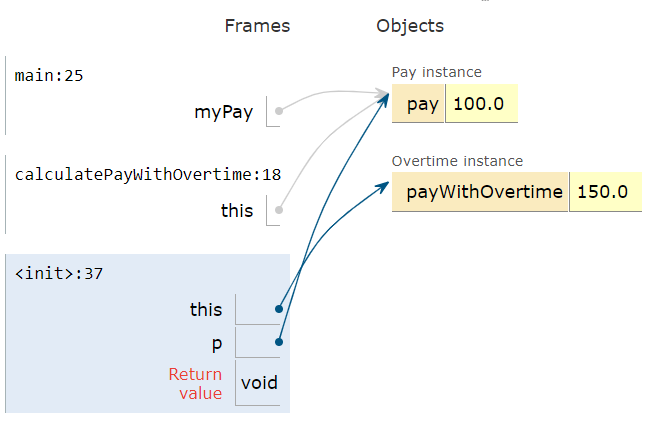
Payclass declares anOvertimeobject and passes inthis(the currentPayobject) to its constructor which computes the overtime with respect to thatPayobject.
Here is an image that shows how this, myPay and p all refer to the same object in memory:
💻 Coding Activity: Bank Account
Many people keep their money in a bank account. The bank may keep track of the account holder’s name, the acount balance which is the amount of money in the account, and assign an account number to each account. At the bank or an ATM (automatic teller machine) or on a phone app, the account holder can deposit (add) or withdraw (subtract) an amount from their account.
🏧 Here’s a ATM video that breaks down the steps to use an ATM to withdraw money from a bank acount. Phone apps like Venmo and Paypal connect to your bank account or credit card to send and get money from businesses or friends.
⭐️ Summary
-
(AP 3.9.A.1) Within an instance method or a constructor, the keyword
thisacts as a special variable that holds a reference to the current object—the object whose method or constructor is being called. -
this.instanceVariablecan be used to distinguish between this object’s instance variables and local parameter variables that may have the same variable names. -
(AP 3.9.A.2) The keyword
thiscan be used to pass the current object as an argument in a method call. -
(AP 3.9.A.3) Class methods do not have a
thisreference.
Acknowledgement
Content on this page is adapted from Runestone Academy - Barb Ericson, Beryl Hoffman, Peter Seibel.